Beginner guides
Hyperscale vs Enterprise Colocation: Which Model Fits Your Workload?
7 min read
Hyperscale data centres and enterprise colocation both house servers, but they are built for very different customers. Here is how they differ in scale, contracts and services, who each suits, and how to evaluate your options.
Two very different kinds of data centre
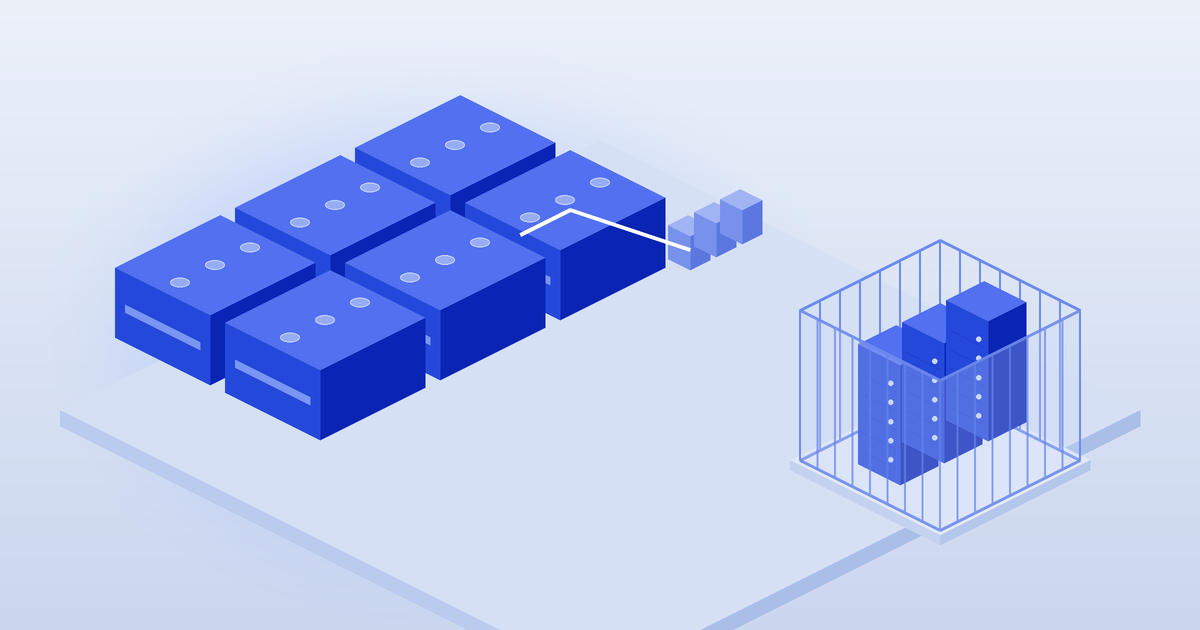
"Data centre" covers a wide range of buildings. At one end are hyperscale campuses built for the largest cloud, content and AI platforms. At the other are enterprise colocation facilities, where many organisations rent racks, cages or suites in a shared building.
Both house servers, power and cooling, but they are designed, sold and run for very different customers. Knowing which model you are actually shopping in saves time, sets realistic expectations on price and contract terms, and helps you shortlist the right facilities. If you are new to the topic, start with our guide to what colocation is.
Definitions and scale
A hyperscale data centre is built to support very large, fast-growing platforms, typically public cloud providers, large content and social media companies, and increasingly AI model builders. Capacity is usually discussed in megawatts rather than racks, and the customer often takes an entire data hall, a whole building or a purpose-built facility on a campus. Some hyperscalers build and run their own sites; others lease capacity from specialist operators that build to the customer's specifications.
Enterprise colocation is shared, multi-tenant space. A facility serves many customers, each renting anything from a single rack to a private cage or suite. The operator provides power, cooling, security, connectivity options and on-site support, and the customer brings and manages its own equipment. Our guide to racks vs cages explains the common footprints.
The difference is not just size. Hyperscale facilities are optimised for huge volumes of fairly standardised equipment operated by the customer's own teams. Enterprise colocation is optimised for variety: different customers, hardware, densities and service needs under one roof.
Contract sizes and terms
Contract structures differ as much as the buildings.
Hyperscale contracts are often measured in megawatts and multi-year terms, and may be agreed well before the capacity is built. They tend to be negotiated individually, with detailed specifications for power, cooling, security and build timelines, and they may include options to expand as the customer grows. Exact terms vary widely and are rarely public, so ask providers directly rather than relying on figures you read in the press.
Enterprise colocation contracts are usually smaller and more standardised. Pricing is commonly built around space, committed power per rack, cross-connects and services such as remote hands. Terms are generally shorter than hyperscale deals, and there is often more flexibility to start small and add racks over time, although minimum terms, notice periods and renewal pricing still matter. Our colocation cost guide explains how the main cost lines work.
In both cases, read the fine print on power commitments, price escalation, service levels, and what happens at the end of the term. Our guide to power, kW and redundancy explains how committed power is usually measured.
Who each model suits
Hyperscale capacity tends to suit:
• Cloud, content and platform companies that need very large amounts of capacity in one place.
• Organisations with in-house engineering and operations teams who want to control the design.
• Large AI training or inference deployments where power availability and high density are the main constraints. See our AI infrastructure guide.
• Buyers who can forecast demand years ahead and commit to it.
Enterprise colocation tends to suit:
• Businesses, government agencies and service providers moving out of server rooms or on-premises data centres.
• Hybrid cloud strategies that need private equipment close to public cloud, often via cloud on-ramps.
• Organisations that want a choice of carriers and cross-connects to partners in the same building.
• Workloads that grow gradually, where flexibility matters more than lowest cost per kW.
Many Australian organisations never need hyperscale capacity directly; they consume it through public cloud services while keeping their own equipment in enterprise colocation. Our guide to choosing between on-prem, colocation and cloud covers that decision.
Where the lines are blurring
The gap between the two models is narrowing. Many operators now run campuses with both large single-customer halls and multi-tenant colocation space. Some enterprise facilities offer high-density and liquid-cooled areas for GPU customers, and some larger enterprises take whole suites on terms that look closer to wholesale deals.
That means labels on a website are less useful than the specifics: what capacity is available now, at what density, on what terms, and with what services. For a wider view of the Australian landscape, see our market overview.
How to evaluate your options
Start with your own requirements rather than the provider's label:
1. Capacity today and in three to five years. How much power do you need now, and how confident is your growth forecast?
2. Density. What kW per rack will your hardware draw, and does the hall support it with the cooling you need?
3. Contract flexibility. Can you start small and expand, and what are the minimum term, notice and renewal conditions?
4. Connectivity. Which carriers, cloud on-ramps and internet exchanges are available in the building?
5. Services. Do you need remote hands, smart hands, secure storage or migration support, or will your own team do everything?
6. Resilience and compliance. What redundancy design, certifications and security controls apply? Our guide to Tier III vs Tier IV helps here.
7. Location. Which city or region best suits your users, latency needs and disaster recovery plans?
Compare facilities in Sydney, Melbourne, Brisbane, Perth, Adelaide and Canberra, and work through our first-time buyer's checklist before you request quotes.
DChunt is independent and does not sell data centre space. Use our comparison tool and provider directory to shortlist facilities, or the free assessment to work out which model and which sites fit your workload.
Frequently asked questions
Not sure how this applies to your business?
The free DChunt assessment turns answers like these into realistic pricing and a provider shortlist for your specific requirements.
Get a free colocation assessment from DChunt